Marxism Unmasked: From Delusion to Destruction by Ludwig Von Mises
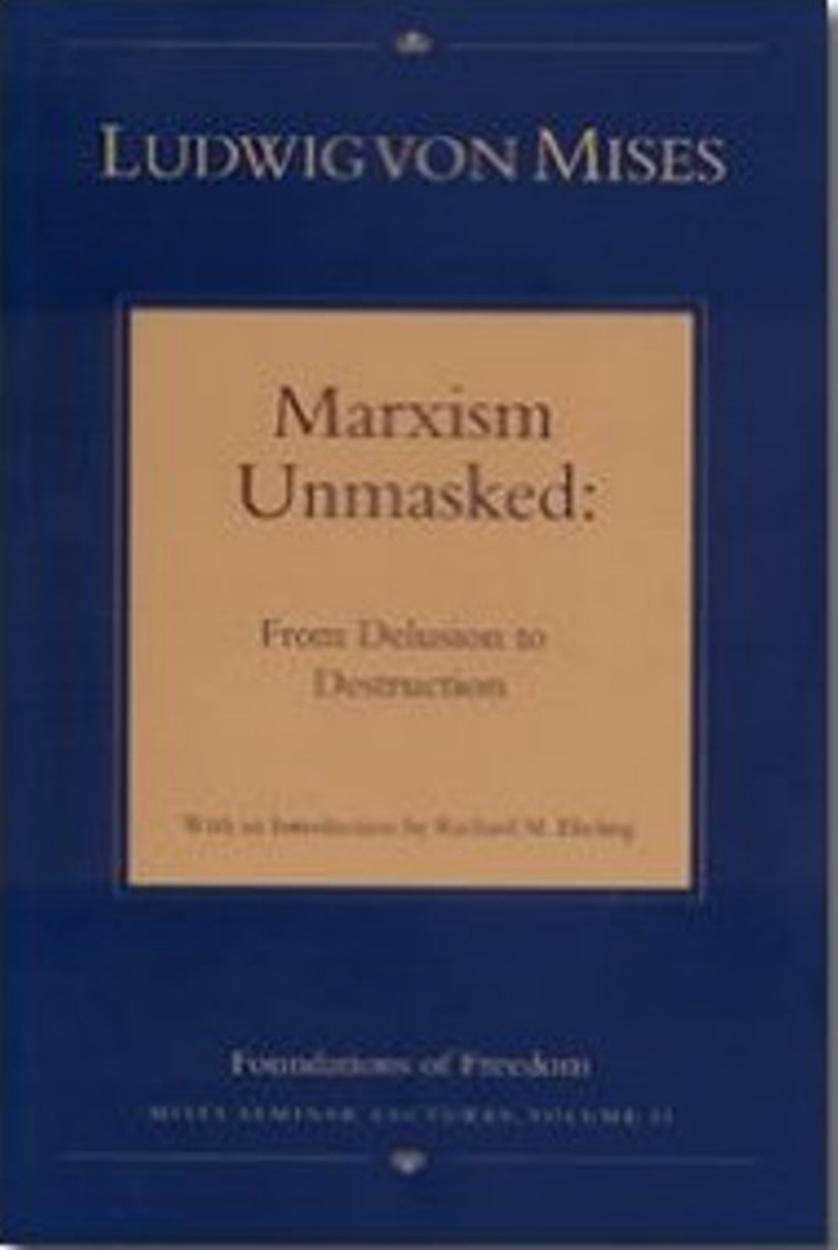
Author:Ludwig Von Mises [Mises, Ludwig Von]
Language: eng
Format: epub, pdf
ISBN: 1572462108
Publisher: Foundation for Economic Education
Published: 2010-12-16T02:00:00+00:00
7TH LECTURE
Money, Interest, and the Business Cycle
THERE ARE TWO PURELY THEORETICAL PROBLEMS which have had serious influences and serious consequences that cannot be exaggerated.
The first of these two problems relates to the taking of interest. This leads us back to Aristotle and his famous dictum, âMoney cannot beget money.â Aristotle found interest a very difficult problem. He was responsible for the error that interest was paid for the use of money. For many centuries, for two thousand years, this was the theoretical basis of the legal prohibition of interest-taking on loans. People saw only the interest on loans; they didnât see that interest stemmed from a general category of human action, that it arose out of the fact that all people by necessity, without any exception, valued present goods higher than future goods. Therefore, this meant that the discounted values and discounted prices of future goods as against present goods could not be eliminated simply by a government fiat, rule, or command. When the Roman Empireâs âcapitalismâ broke down and the highly developed Roman economic system was supplanted by the economy of the invading tribesâan economy that was purely agricultural and based on the self-sufficiency of every householderâs farmâthe general prohibition against the taking of interest was increasingly enforced.
In many parts of Europe there was a struggle against the taking of interest. At the head of this struggle was the Church. For a thousand years, the councils of the Church repeated the unconditional prohibition of interest. But in order to find a theoretical basis for this prohibition they could not use the Gospels and the New Testamentâthey had to go back to the law of Moses. There they found a passage referring to the taking of interest on loans lent to Jews and not to Gentiles. Later at the beginning of the twelfth century the theologians found a passage in the Gospels1which could also be interpreted as being against interest taking. This, however, did not refer specifically to interest taking; it said, âlend, hoping for nothing again.â I think that translation is correct. This raised a problem which we neednât go into, but which was contested by theologians and historians of law.
There was on the one hand the prohibition of the Churchâthe Canon Lawâwhich the Church was very eager to enforceâbut there was on the other hand reality, the practice of the people. Loans were needed. In the countries under the power of the Church, both religious and secular, modern banking was slowly developing. Theologians began to study the question of interest to determine whether or not there were reasons to justify the taking of interest. These studies were the beginning of economic law versus canonistic doctrine. They discussed many issues, and at least eliminated the erroneous belief that the lender extracts something unjust from the borrower by earning interest on money that is lent. Nevertheless that idea is still found in many American textbooks.
There was, however, another question and that question was this: If you increase the supply of
Download
Marxism Unmasked: From Delusion to Destruction by Ludwig Von Mises.pdf
This site does not store any files on its server. We only index and link to content provided by other sites. Please contact the content providers to delete copyright contents if any and email us, we'll remove relevant links or contents immediately.
| Anthropology | Archaeology |
| Philosophy | Politics & Government |
| Social Sciences | Sociology |
| Women's Studies |
The Secret History by Donna Tartt(19466)
The Social Justice Warrior Handbook by Lisa De Pasquale(12290)
Thirteen Reasons Why by Jay Asher(9110)
This Is How You Lose Her by Junot Diaz(7054)
Weapons of Math Destruction by Cathy O'Neil(6465)
Zero to One by Peter Thiel(5939)
Beartown by Fredrik Backman(5927)
The Myth of the Strong Leader by Archie Brown(5623)
The Fire Next Time by James Baldwin(5578)
How Democracies Die by Steven Levitsky & Daniel Ziblatt(5321)
Promise Me, Dad by Joe Biden(5228)
Stone's Rules by Roger Stone(5184)
A Higher Loyalty: Truth, Lies, and Leadership by James Comey(5080)
100 Deadly Skills by Clint Emerson(5023)
Rise and Kill First by Ronen Bergman(4890)
Secrecy World by Jake Bernstein(4864)
The David Icke Guide to the Global Conspiracy (and how to end it) by David Icke(4841)
The Doomsday Machine by Daniel Ellsberg(4617)
The Farm by Tom Rob Smith(4598)
